An introduction to parameterized quantum circuits, the parameter-shift rule, and barren plateaus — with working code examples.
Author
Your Name
Published
March 1, 2024
Overview
A variational quantum circuit (VQC) is a parameterized quantum circuit U(\boldsymbol{\theta}) = \prod_{l=1}^{L} U_l(\theta_l) where each U_l is a unitary gate that depends on a classical parameter \theta_l \in \mathbb{R}.
The goal is to minimize a cost function \mathcal{L}(\boldsymbol{\theta}) = \langle 0 | U^\dagger(\boldsymbol{\theta})\, H\, U(\boldsymbol{\theta}) | 0 \rangle where H is a Hermitian observable.
Show code
%matplotlib inlineimport numpy as npimport matplotlib.pyplot as plt# Apply a dark style that matches the siteplt.rcParams.update({'figure.facecolor': '#111118','axes.facecolor': '#1a1a24','axes.edgecolor': '#1a1a24','axes.labelcolor': '#8888aa','xtick.color': '#8888aa','ytick.color': '#8888aa','grid.color': '#1a1a24','text.color': '#e8e8f0','font.family': 'monospace',})print('Libraries loaded.')
Libraries loaded.
The Parameter-Shift Rule
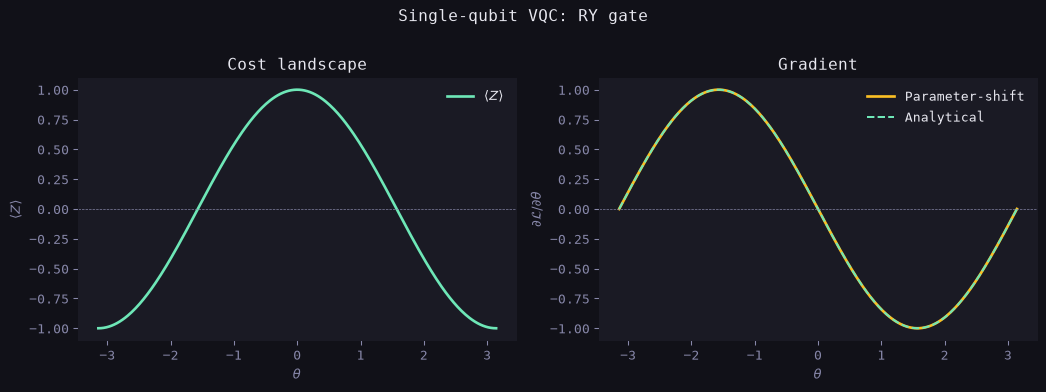
For gates of the form U(\theta) = e^{-i\theta G/2} where G^2 = I, the gradient can be computed exactly via two circuit evaluations:
Below we simulate this for a simple 1-qubit expectation value.
Show code
# Simulate <Z> = cos(theta) for a single RY gate applied to |0>def expectation(theta):"""<Z> after RY(theta)|0>"""return np.cos(theta)def parameter_shift_grad(theta):"""Exact gradient via parameter-shift rule."""return0.5* (expectation(theta + np.pi/2) - expectation(theta - np.pi/2))thetas = np.linspace(-np.pi, np.pi, 300)cost = expectation(thetas)grad = parameter_shift_grad(thetas)true_g =-np.sin(thetas) # analytical derivativefig, (ax1, ax2) = plt.subplots(1, 2, figsize=(11, 4))# Left: cost landscapeax1.plot(thetas, cost, color='#6ee7b7', linewidth=2, label=r'$\langle Z \rangle$')ax1.axhline(0, color='#8888aa', linewidth=0.5, linestyle='--')ax1.set_xlabel(r'$\theta$')ax1.set_ylabel(r'$\langle Z \rangle$')ax1.set_title('Cost landscape', color='#e8e8f0')ax1.legend(framealpha=0)ax1.set_facecolor('#1a1a24')# Right: gradientax2.plot(thetas, grad, color='#fbbf24', linewidth=2, label='Parameter-shift')ax2.plot(thetas, true_g, color='#6ee7b7', linewidth=1.5, linestyle='--', label='Analytical')ax2.axhline(0, color='#8888aa', linewidth=0.5, linestyle='--')ax2.set_xlabel(r'$\theta$')ax2.set_ylabel(r"$\partial\mathcal{L}/\partial\theta$")ax2.set_title('Gradient', color='#e8e8f0')ax2.legend(framealpha=0)ax2.set_facecolor('#1a1a24')fig.suptitle('Single-qubit VQC: RY gate', color='#e8e8f0', fontsize=12, y=1.01)plt.tight_layout()plt.show()
Barren Plateaus
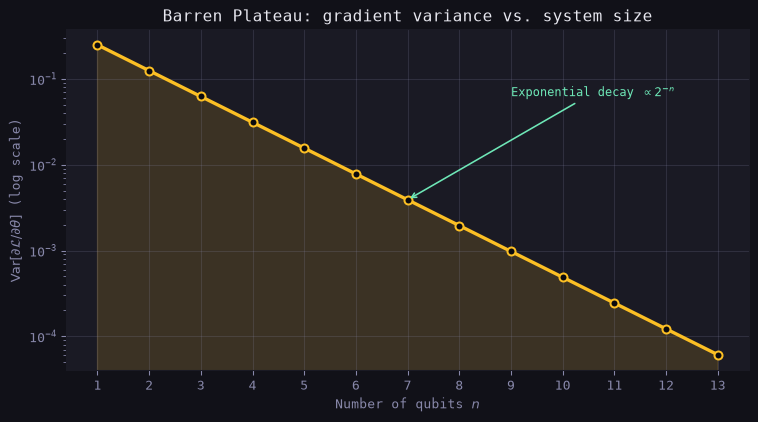
A central challenge in training VQCs is the barren plateau phenomenon: for deep random circuits on n qubits, the variance of the gradient vanishes exponentially, \text{Var}\!\left[\frac{\partial \mathcal{L}}{\partial \theta_k}\right] \in O(2^{-n}).
The plot below illustrates how gradient variance decays with circuit depth.
Show code
np.random.seed(42)n_qubits_list = np.arange(1, 14)# Gradient variance decays as ~2^(-n) for global cost functionsvariance =2.0** (-n_qubits_list.astype(float)) *0.5fig, ax = plt.subplots(figsize=(8, 4.5))ax.semilogy(n_qubits_list, variance, color='#fbbf24', linewidth=2.5, marker='o', markersize=6, markerfacecolor='#0a0a0f', markeredgecolor='#fbbf24', markeredgewidth=1.5)ax.fill_between(n_qubits_list, variance, alpha=0.15, color='#fbbf24')ax.set_xlabel('Number of qubits $n$')ax.set_ylabel(r'$\text{Var}[\partial\mathcal{L}/\partial\theta]$ (log scale)')ax.set_title('Barren Plateau: gradient variance vs. system size', color='#e8e8f0')ax.set_xticks(n_qubits_list)ax.grid(True, alpha=0.2, color='#8888aa')ax.set_facecolor('#1a1a24')# Annotationax.annotate('Exponential decay $\\propto 2^{-n}$', xy=(7, variance[6]), xytext=(9, variance[2]), arrowprops=dict(arrowstyle='->', color='#6ee7b7', lw=1.2), color='#6ee7b7', fontsize=9)plt.tight_layout()plt.show()
Summary
Concept
Key result
Parameter-shift gradient
Exact, hardware-compatible
Barren plateaus
Variance \propto 2^{-n} for global cost
Mitigation strategies
Local cost functions, structured ansätze, QNGO
Next: Noise-resilient gradient estimation — how shot noise and hardware errors compound with barren plateaus.